Acetyl CoA to CO 2. Acetyl CoA links glycolysis and pyruvate oxidation with the citric acid cycle.

Krebs Cycle Citric Acid Cycle Tca Cycle With Steps And Diagram
The reduced form NADH initiates the respiratory chain to regenerate NAD.

2 carbon acetyl coa formula. In the Claisen condensation phase of the reaction the alpha-carbon of a second acetyl CoA is deprotonated forming an enolate Reaction 2. The final cycle produces two separate acetyl CoAs instead of one acyl CoA and one acetyl CoA. Chapter Seven Vocabulary Words Glossary Chapter 7 acetyl CoA a 2-carbon compound acetate or acetic acid to which a molecule of CoA is attached.
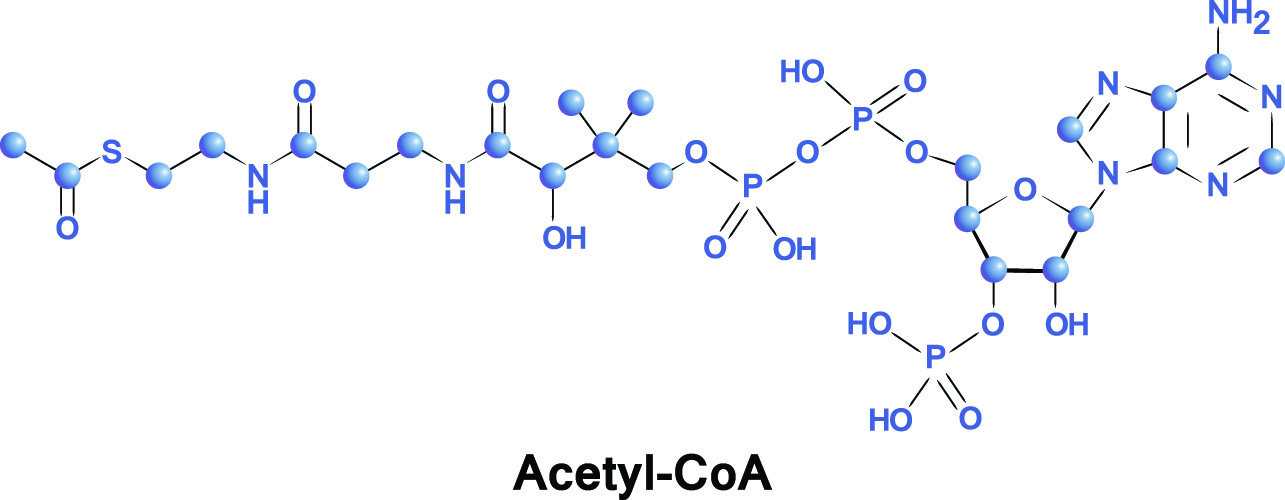
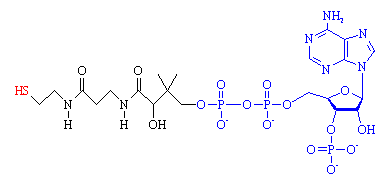
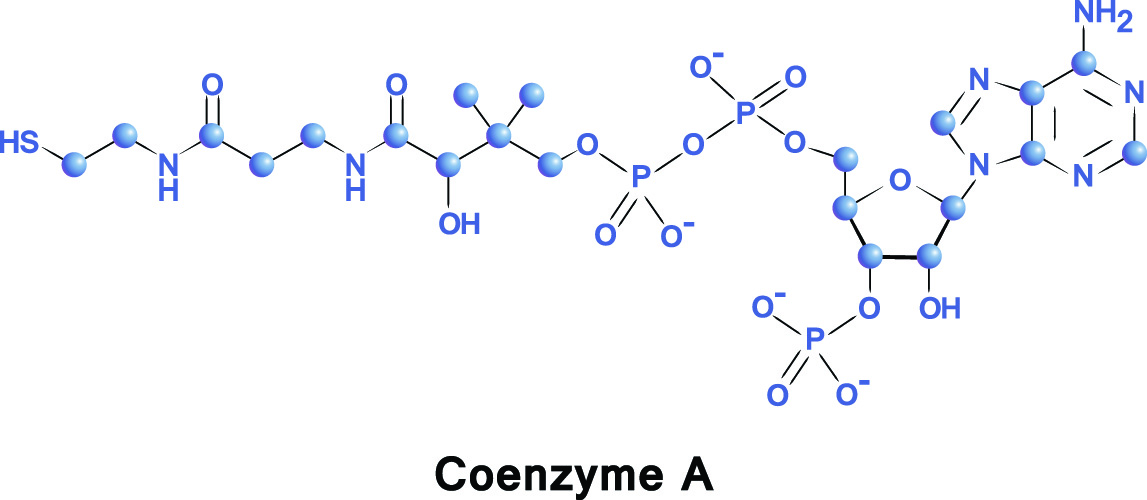
Its chemical reactions oxidize all six of the original carbon atoms to ceCO_2 and capture the energy released in 2 ATP 6 NADH and 2 FADH_2. The acetyl group is picked up by a carrier compound called coenzyme A CoA which is made from vitamin B5. Dis acetyl-coa is an abbreviation for the full form acetyl coenzyme a also this molecule helps in the carbohydrateprotein lipid mechanisms.
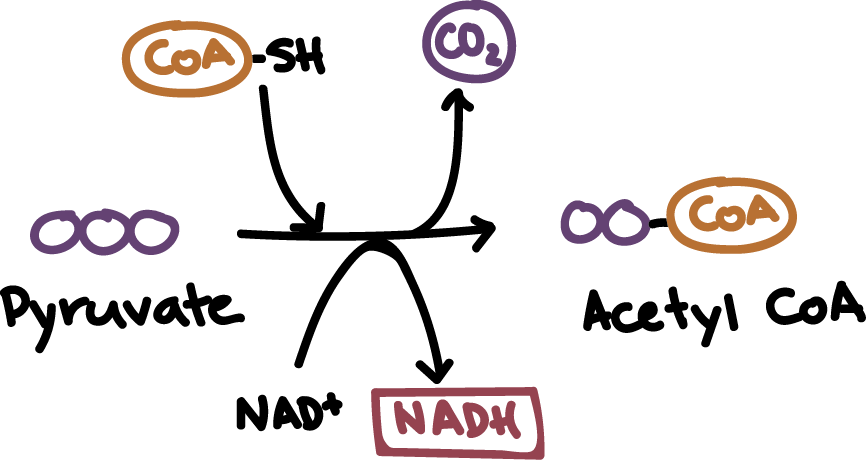
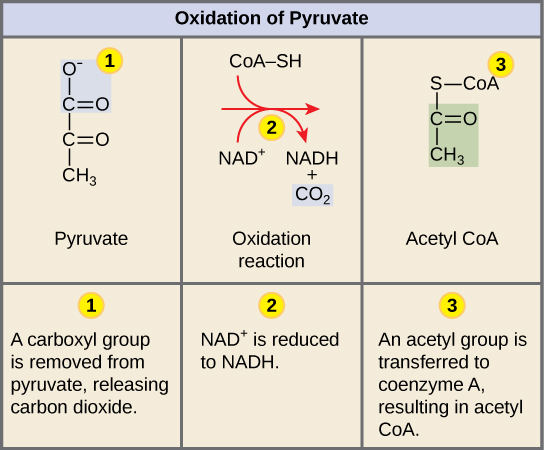
Odd-numbered saturated fatty acids. Pyruvic acid CoA NAD --- acetyl CoA NADH H CO 2 This reaction may be called the oxidative decarboxylation of pyruvic acid to acetyl CoA. This acetyl coa molecule has three Phosphorus atoms.
O 1-3R-4-3-2-Acetylsulfanylethylamino-3-oxopropylamino-3-hydroxy-22-dimethyl-4-oxobutyl O 3-2R3S4R5R-5-6-amino-9H-purin-9-yl-4-hydroxy. Or two acetyl-CoA can be condensed to create acetoacetyl-CoA the first step in the HMG-CoA mevalonic acid. This generates acetyl-CoA according to the following reaction scheme.
Acetyl CoA to CO 2. Acetyl coenzyme A sodium salt. A carboxyl group is snipped off of pyruvate and released as a molecule of carbon dioxide leaving behind a two-carbon molecule.
The essential features are that NAD coenzyme is used to remove 2Hs and 2es from pyruvic acid. Acetyl-CoA can be used to to convey the carbon atoms within the acetyl group to the citric acid cycle to be oxidized for energy production in the citric acid cycle or can become ketone bodies. Whats the chemical formula of acetyl-CoA.
Acetyl CoA can be used in a variety of ways by the cell but its major function is to deliver the acetyl. In the presence of oxygen acetyl CoA delivers its acetyl group to a four-carbon molecule oxaloacetate to form citrate a six-carbon molecule with three carboxyl groups. Acetylcoa is an organic compound with the functional group thioester.
89 atoms - 38 Hydrogen atoms 23 Carbon atoms 7 Nitrogen atoms 17 Oxygen atoms 3 Phosphorous atoms and 1 Sulfur atoms. The enolate carbon attacks the electrophilic thioester carbon forming a tetrahedral intermediate Reaction 3 which quickly collapses to expel the cysteine thiol Reaction 4 and produce acetoacetyl CoA. -while the products of both saturated and unsaturated are the same the mechanism is slightly different due to the pi bonds that already exist in the unsaturated fats.
How many atoms and what are the elements included the acetyl-CoA molecule. It also is used to produce acetylcholine. This also produces NADH.
Adenosine triphosphate a common high-energy compound composed of a purine adenine a sugar ribose and three phosphate groups. Concomitantly one molecule of FADH 2 NADH and acetyl CoA are formed. This process continues until the entire chain is cleaved into acetyl CoA units.
And its chemical formula is c23h38n7o17p3s. -both saturated and unsaturated fats will yield 2 2-carbon acetyl CoA and 2 4-carbon acetyl CoA which then will subsequently break down into 2 2-carbon acetyl CoA. Acetyl CoA links glycolysis and pyruvate oxidation with the citric acid cycle.
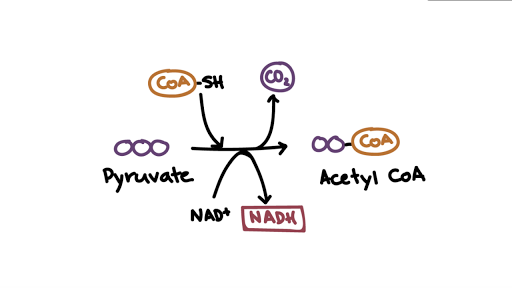
A brief summary of Acetyl CoA formation. CH 3 COCOO pyruvate HSCoA NAD CH3COSCoA acetyl-CoA NADH H CO 2. To do such an important process 2 pyruvate 2 NAD and 2 CoA are needed to produce 2 acetyl CoA 2 NADH 2H and 2 CO2.
Ammonia a compound with the chemical formula NH 3. For every cycle the Acyl CoA unit is shortened by two carbon atoms. The resulting compound is called acetyl CoA Figure 2.
In the mitochondrial matrix a carboxyl group is removed releasing CO2 and NAD helps to remove hydrogens and electrons from the pyruvate making it possible to add coenzyme A thus creating Acetyl CoA. The two-carbon molecule from step 1 is oxidized and the electrons lost in the oxidation are picked up by to form. The product of this reaction acetyl-CoA is the starting point for the citric acid cycle.
These energy carriers join the 2 ATP and 2 NADH produced in glycolysis and the 2 NADH produced in the conversion of 2 pyruvates to 2 acetyl-CoA molecules. During this first step of the citric acid cycle the CoA enzyme which. The oxidized two-carbon moleculean acetyl group highlighted in greenis attached.
In the mitochondrial matrix pyruvate will be transformed into a two-carbon acetyl group by removing a molecule of carbon dioxide. These 2 acetyl CoA are then. In the presence of oxygen acetyl CoA delivers its acetyl group to a four-carbon molecule oxaloacetate to form citrate a six-carbon molecule with three carboxyl groups.
Pyruvate Oxidation Cellular Respiration Article Khan Academy

Acetyl Coa An Overview Sciencedirect Topics
Pyruvate Dehydrogenase And The Citric Acid Cycle

What Is Acetyl Coa Quora

Fatty Acids Structure Of Acetyl Coa
Krebs Cycle An Overview Sciencedirect Topics

Major Products Of The Dnl Pathway Acetyl Coenzyme A Acetyl Coa Is Download Scientific Diagram
Acetyl Coa The Definitive Guide Biology Dictionary
Acetyl Coenzyme A Molecule Of The Month May 2007 Html Only Version

Pyruvate Oxidation Biology For Majors I
Pyruvate Oxidation Cellular Respiration Article Khan Academy
Acetyl Coa The Definitive Guide Biology Dictionary

Acetyl Coa An Overview Sciencedirect Topics

Oxidation Of Pyruvate And The Citric Acid Cycle Boundless Biology

Acetyl Coa An Overview Sciencedirect Topics

Acetyl Coa An Overview Sciencedirect Topics
Pyruvate Oxidation Cellular Respiration Article Khan Academy

Oxidation Of Pyruvate And The Citric Acid Cycle Boundless Biology

Acetyl Coa An Overview Sciencedirect Topics

